

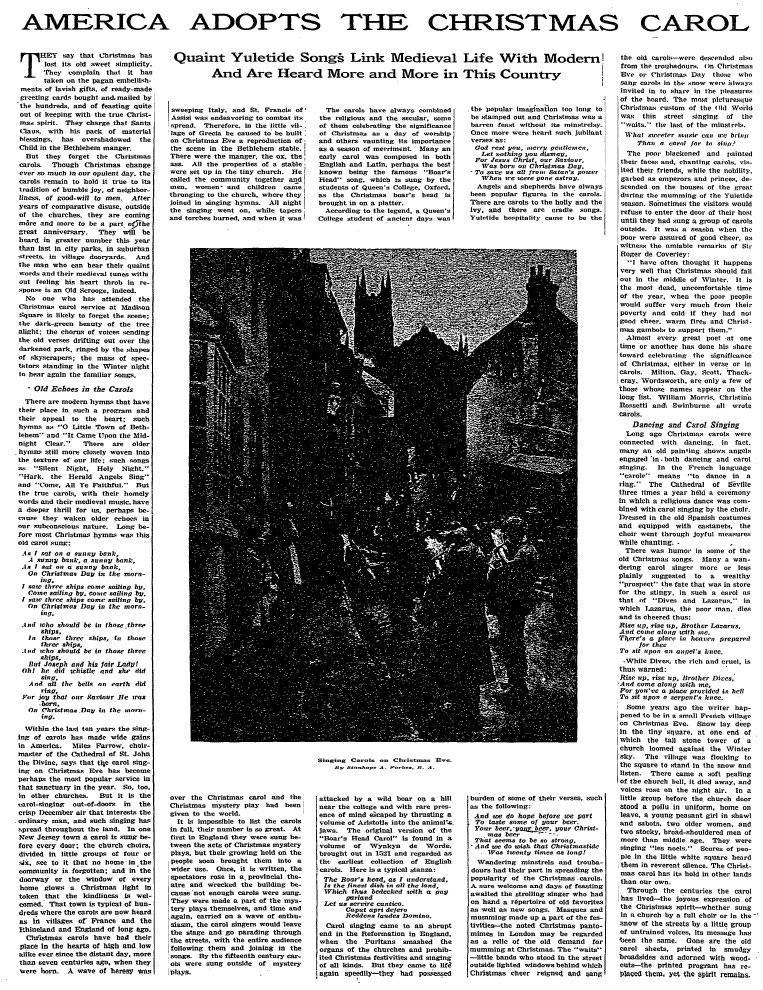
In 1925, Christmas carols were becoming far more popular, reported New York Times Magazine. By my count, only two of this week’s Billboard top 50 Christmas songs were in existence by 1925.
First, let’s travel back a century. A December 1925 New York Times Magazine article, with no byline, wrote:
Within the last ten years the singing of carols has made wide gains in America.
…
After years of comparative disuse, outside of the churches, they are coming more and more to be a part of the great anniversary. They will be heard in greater number this year than last in city parks, in suburban streets, in village dooryards.
The article goes on to specifically cite three carols as “closely woven into the texture of our life”: Silent Night; Hark, the Herald Angels Sing; and Come, All Ye Faithful.
Nowadays, not so much.
Here’s this week’s Billboard Hot 100 chart, where precisely 40 of the top 50 songs are Christmas- or holiday-themed. By my count, only two of them were in existence by 1925. (And even then, the versions that chart today were recorded after 1925.)
#20: Jingle Bells by Frank Sinatra, recorded in 1948 but written in 1857
#23: Deck the Halls by Nat King Cole, recorded in 1960 but written in 1862
A bunch of others that we now considered holiday “classics” are actually from the 1930s and on, including Santa Claus is Comin’ to Town from 1934, White Christmas by Bing Crosby from 1942, and Rudolph the Red-Nosed Reindeer by Gene Autry from 1949.
Of course, the current #1 – a status it reaches literally every December – is All I Want for Christmas is You by Mariah Carey. A century from now in 2125, when nobody is still alive who remembers Carey’s 1990s-2000s heyday, will the song be inadvertently misremembered as a “timeless” tune like a Jingle Bells or Deck the Halls, rather than the ‘90s song we’re still close enough in time to remember it as now?
America Adopts the Christmas Carol: Quaint Yuletide Songs Link Medieval Life With Modern And Are Heard More and More in This Country
Published: Sunday, December 20, 1925