

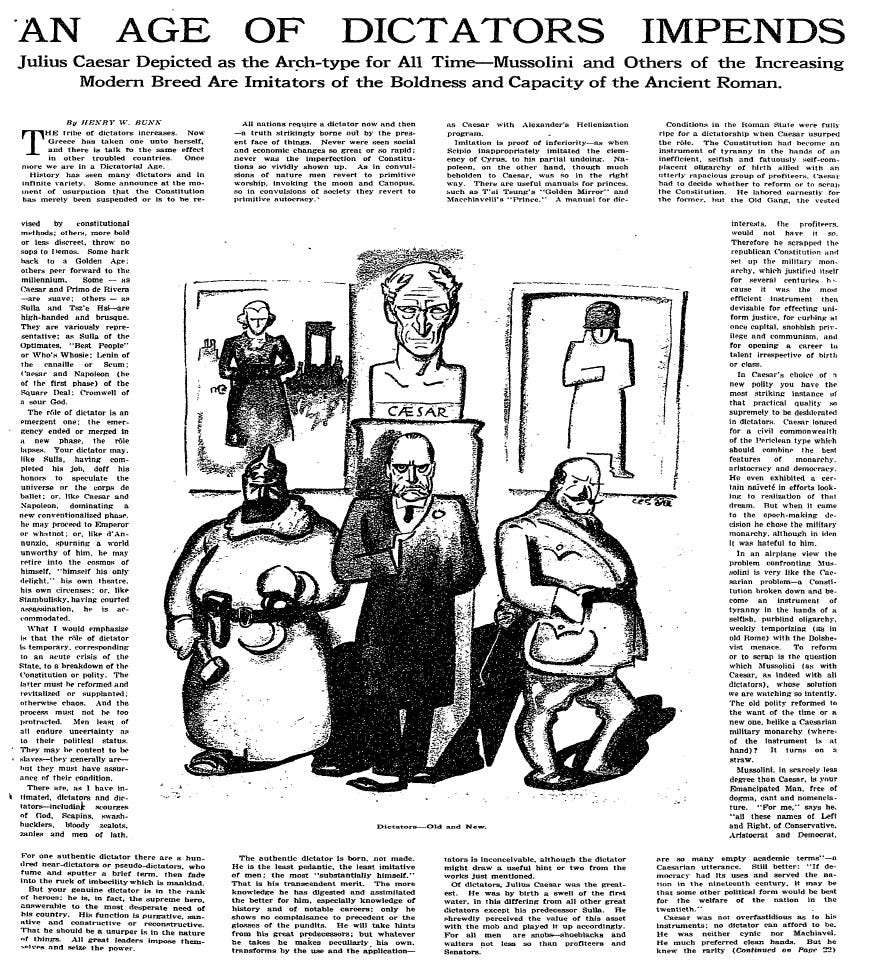
“An age of dictators impends,” declared a 1926 New York Times Magazine headline… seven years before Hitler became Chancellor of Germany in 1933.
Indeed, the two main examples that journalist Henry W. Bunn cited in his January 1926 article were Italy’s Benito Mussolini and Greece’s Theodoros Pangalos:
The tribe of dictators increases. Now Greece has taken one unto herself, and there is talk to the same effect in other troubled countries. Once more we are in a Dictatorial Age.
Mussolini became Prime Minister in 1922 and quickly expanded his powers over the next few years, but arguably became a “dictator” the month before this article was published, in December 1925. That month, a new law said he could only be removed by Italy’s king and no longer by its parliament.
Pangalos took charge of Greece following a so-called “bloodless coup” in June 1925, seven months before this article. He declared a state of emergency and assumed dictatorial powers in early January 1926, mere weeks before this article. His reign was short-lived, though: another coup later in the year, led by a military general in August 1926, deposed Pangalos and imprisoned him for two years.
That might explain why Pangalos is virtually unknown to the average person today –certainly compared to Mussolini, who remains an infamous figure to this day, largely due to his later role as one of the preeminent figures during World War II.
Bunn’s 1926 journalism article itself was actually mostly a history article, about Julius Caesar and how he set the prototype for more modern dictators. But in an interesting paragraph, Bunn also wrote that dictators were sometimes necessary, in his view:
All nations require a dictator now and then – a truth strikingly borne out by the present face of things. Never were seen social and economic changes so great or so rapid; never was the imperfection of constitutions so vividly shown up.
One wonders whether Bunn would make the same argument today: another time of “great social and economic changes,” and one increasingly marked by more autocratic leaders – including Vladimir Putin in Russia, Viktor Orbán in Hungary, Nayib Bukele in El Salvador, Narendra Modi in India, and Nicolás Maduro in Venezuela… at least up until a few weeks ago.
An Age of Dictators Impends: Julius Caesar Depicted as the Arch-type for All Time – Mussolini and Others of the Increasing Modern Breed Are Imitators of the Boldness and Capacity of the Ancient Roman
Published: Sunday, January 24, 1926