

During America’s prohibition on alcohol, some Germans advocating a similar national policy. A 1926 New York Times Magazine article detailed why the movement faced a much more uphill battle there.
Namely, World War I helped get Prohibition across the finish line in America… but was simultaneously the biggest reason it wouldn’t pass in Germany.
As an article from the Mob Museum (of all places) notes:
World War I provided the final solid push toward a constitutional amendment by making temperance synonymous with patriotism, thrift, and prudence.
…
By connecting alcohol production (and consumption) with German, Irish, Catholic, and Jewish Americans, temperance was framed as an ‘us vs. them’ problem… A large percentage of breweries were owned and operated by German Americans. They argued that every dollar put into the brewers’ pockets, and every bushel of grain diverted to a brewery, aided the German war effort.
This sentiment was expressed in a quote from a 1918 speech by former Wisconsin Lt. Gov. John Strange:
“We have German enemies across the water. We have German enemies in this country, too. And the worst of all our German enemies, the most treacherous, the most menacing, are Pabst, Schlitz, Blatz, and Miller.’”
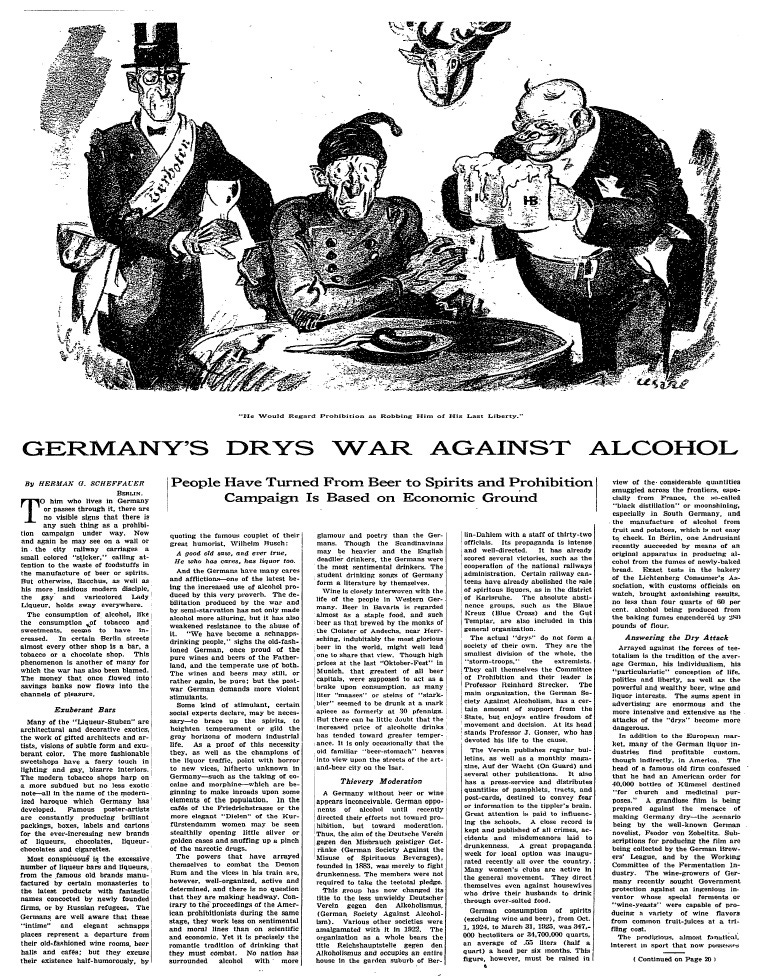
In a January 1926 New York Times Magazine article, though, journalist Herman G. Scheffauer reported from Berlin that the after-effects of World War I would likely prevent Germany from enacting Prohibition there.
Germany was in dire straits after World War I – so dire that it created the conditions allowing Hitler to reach power. Indeed, as the Treaty of Versailles ending World War I was signed in 1919, its punishments for Germany were so harsh that France’s Ferdinand Foch supposedly remarked: “This is not a peace. It is an armistice for twenty years.”
After World War II, the Allies learned their lesson and implemented the Marshall Plan to help rebuild Germany, rather than punish it, in an effort to make sure the economic conditions which “created Hitler” couldn’t emerge once again.
Indeed, today Germany is one of the wealthiest economies in the world: #3 behind only the U.S. and China.
But in 1926, none of this was yet known. Scheffauer reported that Germany was in such bad shape after World War I, unlike America, that alcohol was one of its few remaining (or perhaps even only) pleasures afforded to its populace:
To paint an utterly beerless or wineless Fatherland to the German is like asking him to believe in the imminent end of the world. And to hold up the example of America, with its bootleggers and high prices, is to call up memories of his years of dearth, of “ersatz” foods and drinks and extortion by profiteers. He would regard prohibition as robbing him of his last liberty – the last, even if artificial, joy left him in a land upon which so many political and economic shadows rest.
Indeed, Germany would never ultimately enact alcohol prohibition after all.
Germany’s Drys War Against Alcohol: People Have Turned From Beer to Spirits and Prohibition Campaign Is Based on Economic Ground
Published: Sunday, January 31, 1926