

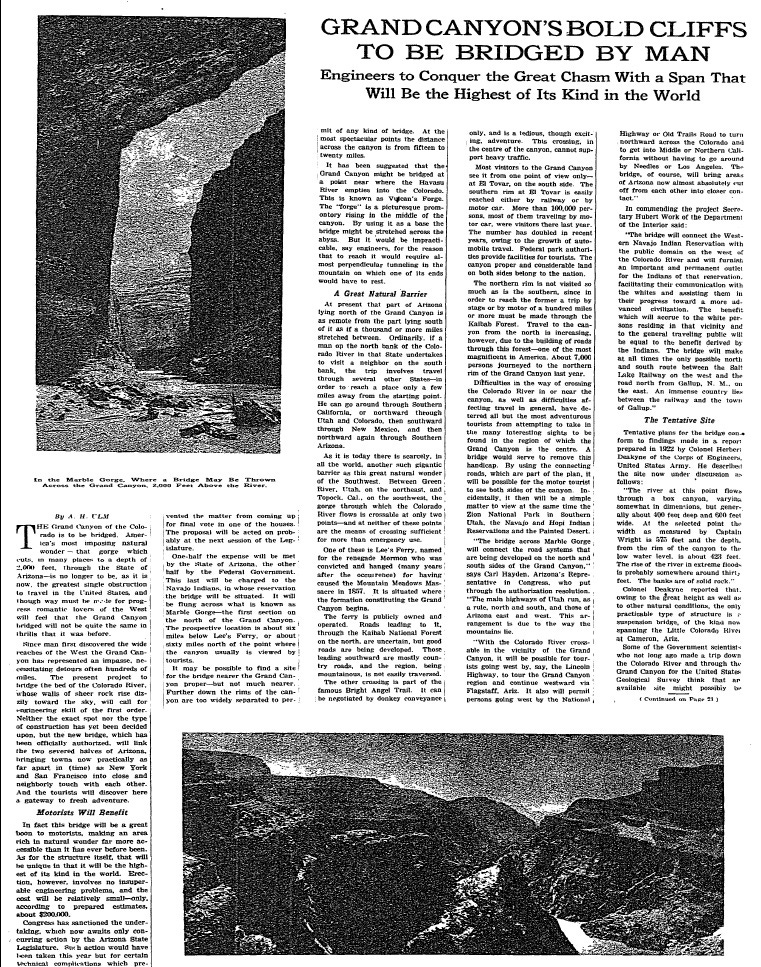
The bridge planned to span the Grand Canyon, a 1925 New York Times Magazine article predicted, would end what was then called “the single greatest obstruction to travel in the United States.”
The journalist A.H. Ulm wrote:
Since man first discovered the wide reaches of the West, the Grand Canyon has represented an impasse, necessitating detours often hundreds of miles. The present project to bridge the bed of the Colorado River, whose walls of sheer rock rise dizzily toward the sky, will call for engineering skill of the first order.
Neither the exact spot nor the type of construction has yet been decided upon, but the new bridge, which has been officially authorized, will link the two severed halves of Arizona, bringing towns now practically as far apart in time as New York and San Francisco into close and neighborly touch with each other.
Indeed, construction began in June 1927, and the bridge officially opened in June 1929. Originally called the Grand Canyon Bridge, the Arizona legislature changed the name to the Navajo Bridge in 1934.
But while the 1925’s article claimed that the project’s estimated price would be “about $200,000,” the bridge actually cost $390,000. Ah, government.
Grand Canyon’s Bold Cliffs to be Bridged by Man: Engineers to Conquer the Great Chasm With a Span That Will Be the Highest of Its Kind in the World
Published: Sunday, December 27, 1925