

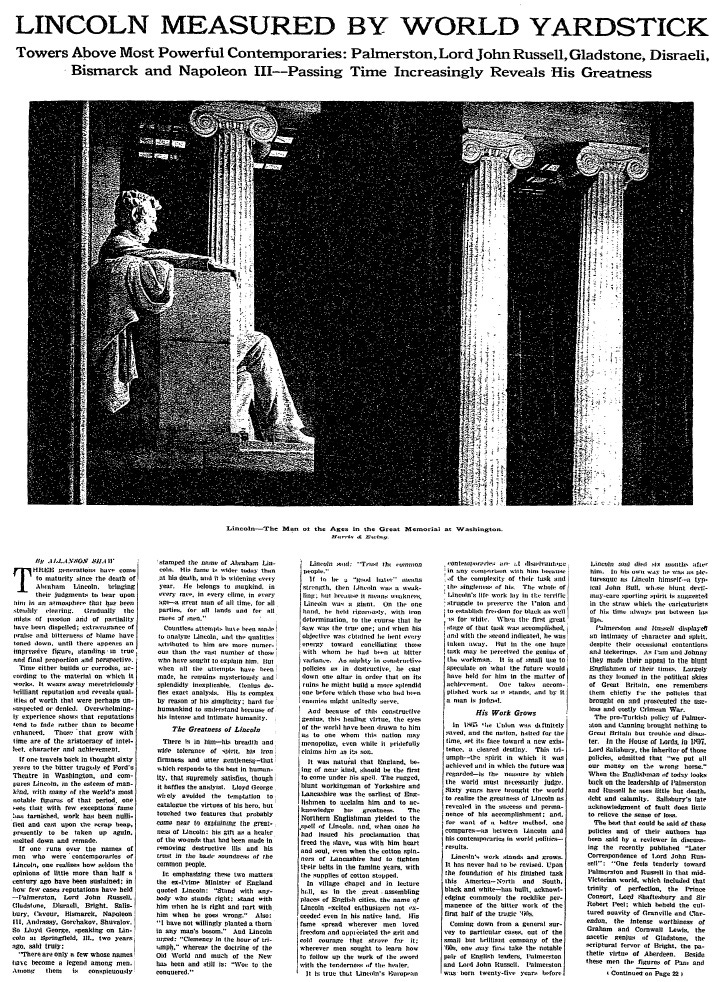
61 years after Abraham Lincoln’s death, he was still universally known, reported a 1926 New York Times Magazine article – unlike 12 of Lincoln’s contemporaneous world leaders. Who were these other dozen men mentioned, and why did their name recognition plummet?
The journalist Allanson Shaw wrote:
If one travels back in thought sixty years to the bitter tragedy of Ford’s Theatre in Washington, and compares Lincoln, in the esteem of mankind, with many of the world’s most notable figures of that period, one sees that with few exceptions fame has tarnished, work has been nullified and cast upon the scrap heap, presently to be taken up again, melted down and remade.
If one runs over the names of men who were contemporaries of Lincoln, one realizes how seldom the opinions of little more than half a century ago have been sustained; in how few cases reputations have held – Palmerston, Lord John Russell, Gladstone, Disraeli, Bright, Salisbury, Cavour, Bismarck, Napoleon III, Andrássy, Gorchakov, Shuvalov.
Who?
Here’s a quick rundown of who each of those 12 men were, and what they were doing during Lincoln’s presidency:
Lord Palmerston: British Prime Minister from 1859-65 during the U.S. Civil War. Officially neutral in the conflict.
Lord John Russell: British Foreign Secretary, their equivalent of the U.S. Secretary of State, from 1859-65. Served as Prime Minister both before and after, from 1846-52 and again from 1865-66.
William Gladstone: British Chancellor of the Exchequer, their equivalent of the U.S. Treasury Secretary, from 1859-66. Later served as Prime Minister for four different stints, starting in 1868 and ending in 1894.
Benjamin Disraeli: A Conservative Party member and key figure in the British opposition. Later served as Prime Minister for two different stints, starting in 1868 and ending in 1880.
John Bright: A notable British member of Parliament, serving in the Liberal Party during Lincoln’s presidency. (Though he would later change parties.)
Lord Salisbury: Member of British Parliament from the Conservative Party. Later served as Prime Minister for three different stints, starting in 1885 and ending in 1902.
Camillo Cavour: A key figure in the Italian unification movement, occurring during Lincoln’s presidency. He became the first Prime Minister of Italy in 1861.
Otto von Bismarck: Minister-president of Prussia from 1862 to 1890, later oversaw the unification of Germany and became Germany’s first chancellor from 1871-90.
Napoleon III: Emperor of France from 1852 to 1870. (Despite his name, he was actually the nephew of Napoleon Bonaparte, not his son or grandson.)
Gyula Andrássy: At the time a member of the Hungarian House of Representatives, he later became Hungary’s Prime Minister from 1867-71.
Alexander Gorchakov: Russian Foreign Minister from 1856-82, considered one of the most important and admired diplomats of the era.
Pyotr Shuvalov: An influential Russian statesman and advisor to Tsar Alexander II, emperor of Russia from 1855-81.
You never really know who will last in the public consciousness.
I’ve been running this blog for a few years now, during which time “the president from 100 years ago” included both Warren G. Harding and Calvin Coolidge. They were plenty talked-about and written-about at the time. Probably not quite as much as Trump is right now, but still. Yet fast-forward to today, and a survey found both Harding and Coolidge rank among the least-remembered presidents.
Bringing it back to Lincoln again… of the four assassinated U.S. presidents, everybody can name two of them but almost nobody outside of historians can name the other two. Obviously, the two “iconic” ones are Lincoln and John F. Kennedy. The other two are James Garfield and William McKinley.
At the actual time, I’ll bet a lot of Americans were certain Garfield and McKinley would be remembered. “They were assassinated? How could anybody forget that?!” And yet, for the most part, they were.
Lincoln Measured by World Yardstick: Towers Above Most Powerful Contemporaries: Palmerston, Lord John Russell, Gladstone, Disraeli, Bismarck, and Napoleon III – Passing Time Increasingly Reveals His Greatness
Published: Sunday, February 7, 1926