

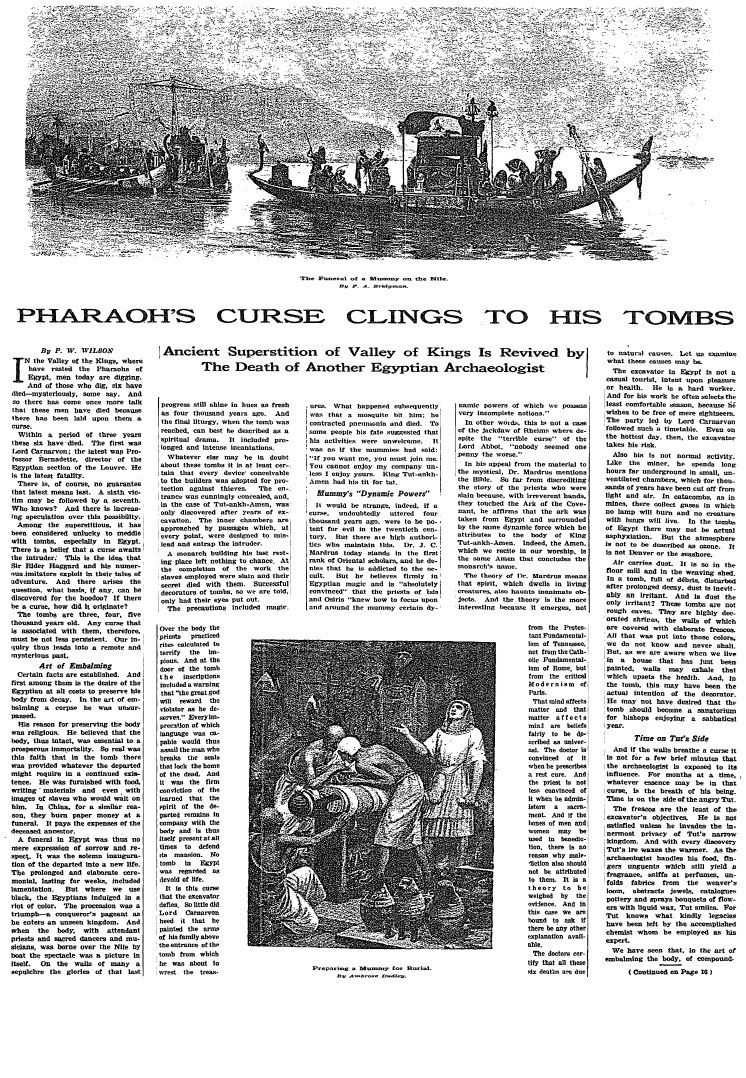
Three years after King Tut’s tomb was opened in Egypt, six people associated with the opening had died, spreading the now-common notion of a “curse.” Though it’s widely known now, a 1926 New York Times Magazine article marked one of the curse’s earliest references.
The journalist P.W. Wilson wrote:
Within a period of three years, six have died. The first was Lord Carnarvon; the latest was Professor Bernadette, director of the Egyptian section of the Louvre. He is the latest fatality.
There is, of course, no guarantee that latest means last. A sixth victim may be followed by a seventh. Who knows?
Supposedly there was indeed a seventh: A. C. Mace, a member of the original 1922 excavation team, who died in 1928.
Still, Howard Carter, the actual lead on the excavation, wouldn’t die until 1939. Surely that’s long enough afterwards that you can’t blame it on a curse. (Frankly, I’m not even sure that Mace’s 1928 death six years later could be, either?)
Indeed, a 2002 study found that the average age of death among those present when the tomb was first opened was no different from the statistical average.
Pharaoh’s Curse Clings to His Tombs: Ancient Superstition of Valley of Kings Is Revived by The Death of Another Egyptian Archaeologist
Published: Sunday, April 11, 1926