

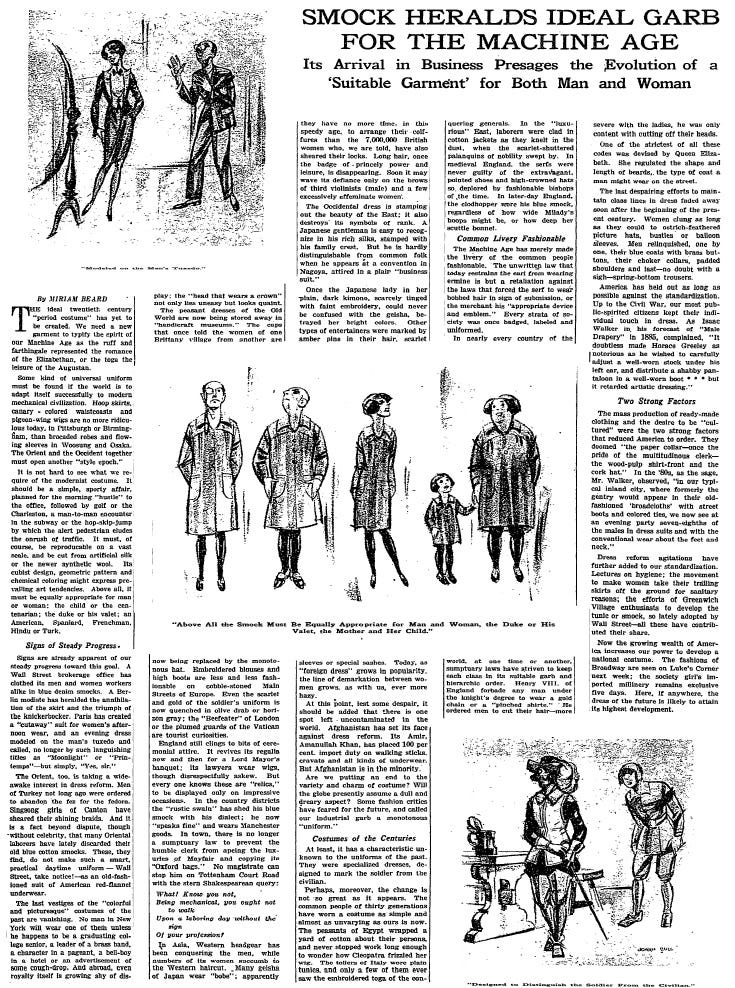
A 1926 New York Times Magazine article seemed to foretell the rise of the trench coat as a fashion trend – even as the author called it a “smock” instead.
The journalist Miriam Beard wrote:
The ideal twentieth century “period costume” has yet to be created. We need a new garment to typify the spirit of our Machine Age as the ruff and farthingale represented the romance of the Elizabethan, or the toga the leisure of the Augustan.
Some kind of universal uniform must be found if the world is to adapt itself successfully to modern mechanical civilization.
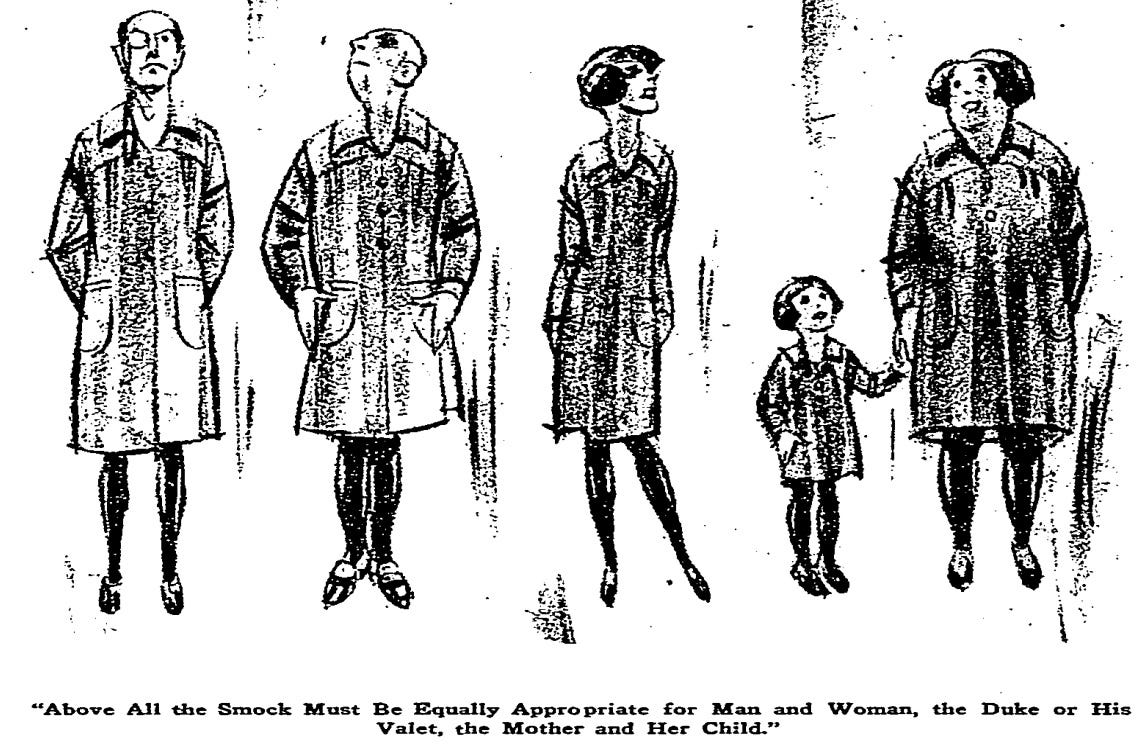
She then goes on to describe what such a “universal uniform” might look like, nicknaming it a “smock,” and the accompanying illustration looked more or less like a trench coat.
So I looked up the history of the trench coat. Linda Rodriguez McRobbie wrote a fascinating article for Smithsonian Magazine, noting that the garment was first popularized in World War I when soldiers wore it in the trenches.
Sure, it seems so obvious once you see it… but I’d never really thought about the term’s linguistic origin before. McRobbie makes the same point in her article: “As the trench coat has become a fashion staple, on every fashion blogger’s must-have list, its World War I origins are almost forgotten.”
The clothing item moved from military to civilian popularity in the 1920s, but truly took off more in the 1930s and 1940s with appearances in Hollywood classics like 1941’s The Maltese Falcon and 1942’s Casablanca.
The article quotes Jane Tynan, lecturer in design history at University of the Arts London and author of British Army Uniform and the First World War: Men in Khaki, about why it became popular in the 1920s after World War I ended.
“The war-worn look was most attractive, not the fresh faced recruit with his spanking new uniform, but the guy who comes back. He’s got his hat at a jaunty angle... the idea was that he had been transformed, he looked like the picture of experience. I think that would certainly have given [the trench coat] a caché, an officer returning with that sort of war-worn look and the trench coat is certainly part of that image.”
Unlike much of 1920s fashion, such as the bobbed haircut or flapper dresses, the trench coat actually seems to have survived to today. Though it hardly seems as popular as it did closer to a century ago, at least it still exists. You see people wearing them more than zero.
Meanwhile, a short biography of the original 1926 article’s author Miriam Beard can be found in a guest post by her granddaughter Karen Vagts on Craig Thompson’s travel blog Clearing Customs, here.
Smock Heralds Ideal Garb for the Machine Age: Its Arrival in Business Presages the Evolution of a ‘Suitable Garment’ for Both Man and Woman
Published: Sunday, February 14, 1926